

From Bittering Agents to Bioactive Marvels
Abstract
Hops (Humulus lupulus L.) are indispensable to brewing, primarily because their cone-derived lupulin glands deliver bitterness, aroma, and improved microbiological stability. Beyond these classical roles, hops contain diverse secondary metabolites, bitter acids, essential-oil volatiles, and polyphenols/prenylflavonoids, that are increasingly studied for functional and bioactive properties relevant to food preservation, cosmetics, and health-oriented applications. This review synthesises current knowledge on hop chemistry and nomenclature, links major chemical classes to beer sensory quality (including multisensory and matrix-driven effects), summarises evidence for key bioactivities, and highlights terroir-driven variability and its consequences for flavour consistency and diversification.
Keywords: Humulus lupulus; lupulin glands; α-acids; β-acids; hop essential oil; polyphenols; xanthohumol; sensory interactions; terroir; beer flavour.
1. Introduction: The Hidden Complexity of Hops
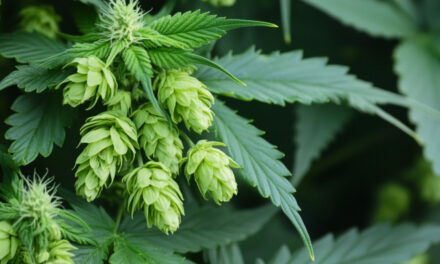
Hops are used in brewing for their capacity to provide bitterness and aroma while enhancing foam and microbiological stability. Contemporary hop research emphasises that these brewing-relevant functions arise from a chemically complex mixture of resins, essential oils, and polyphenols concentrated in lupulin glands of female cones. This same chemical diversity underpins growing interest in hop-derived bioactivities (e.g., antimicrobial, antioxidant and anti-inflammatory effects) and potential applications beyond beer.
2. The Chemistry of Hops: Unpacking Lupulin Glands
The brewing value of hops is largely localised in lupulin glands, the resinous structures formed primarily at the base of bracteoles in female hop cones, where resins and essential oils are synthesised and stored. These glandular metabolites include bitter acids (within resin fractions), a highly complex essential-oil volatile mixture, and polyphenolic/prenylated compounds with both sensory and biological relevance.
2.1 Alpha and Beta Acids: The Foundation of Bitternes
α-Acids (humulones) are central to beer bitterness because they are extracted into wort and thermally isomerised during boiling to the more soluble iso-α-acids, which dominate perceived bitterness and contribute to beer’s microbial stability, particularly against Gram-positive bacteria.
β-Acids (lupulones) are structurally related bitter acids that contribute to hop character and are widely discussed for antimicrobial potential and broader biological activities; their lower solubility and different reactivity mean their contributions to bitterness and stability differ from iso-α-acids, but they remain relevant to beer quality and downstream applications.
2.2 Essential Oils: The Aromatic Signature
Hop essential oil, typically a minor fraction of dried cone mass, is nevertheless a major driver of “hoppy” aroma and flavour due to the potency and diversity of its volatiles. The oil comprises multiple chemical classes (including terpene hydrocarbons, oxygenated terpenoids, esters, aldehydes/ketones, and sulphur-containing compounds), and its composition varies markedly by variety, growing conditions, and processing, factors that complicate prediction of the final sensory outcome in beer.
2.3 Polyphenols: The Unsung Heroes
Hop polyphenols include flavonoids, tannins, and prenylated flavonoids (notably xanthohumol), which contribute to mouthfeel attributes (e.g., astringency) and are repeatedly highlighted for bioactive potential (e.g., antioxidant and anti-inflammatory effects). While beer is not a controlled delivery system for these compounds, their presence motivates interest in hop extracts and refined fractions for non-brewing applications.
3. Hops and Beer Quality: More Than Bitterness
Hops influence beer in multifaceted ways beyond simple bitterness.
3.1 Bitterness and Foam Stability
In brewing practice, α-acids supply the principal bitterness after isomerisation, while hop-derived resins also support foam stability and lacing through interactions with beer components (including proteins). In parallel, hop bittering constituents contribute to microbiological robustness of beer, historically reinforcing the technological rationale for hop use.
- Alpha acids ensure consistent bitterness through isomerisation during boiling.
- Hop resins stabilise beer foam by interacting with proteins in the beer matrix.
- Beta acids contribute long-lasting bitterness, particularly in aged beers.
3.2 Aromatic Complexity
“Hoppy” aroma is not attributable to a single molecule; rather, it emerges from complex mixtures, concentration-dependent effects, and transformations and losses across the brewing process. The diversity of hop oil chemistry and varietal specificity (including the presence/absence and ratios of key odorants) explain why hop variety selection and product choice are central levers for flavour design.
- Hop Variety: Different varieties offer distinct aroma profiles (e.g., Cascade for citrus, Saaz for earthy tones).
- Essential Oil Content: Linalool and geraniol are key aromatic drivers.
- Timing of Hop Addition: Kettle, whirlpool, or dry hopping each emphasizes different aroma compounds.
3.3 Mouthfeel and Astringency
Hop polyphenols can promote astringency and modify tactile sensations, while ethanol and carbonation influence flavour release and oral perception. Importantly, hop-derived volatiles may contribute not only to aroma but also to multisensory perception through interactions with taste and trigeminal sensations, meaning hop “flavour” is best treated as a system-level sensory output rather than a linear sum of parts.
- Hop polyphenols contribute to a dry, astringent finish in certain beer styles.
- Interactions with carbonation and ethanol create a balanced mouthfeel.
4. Bioactive Potential of Hops: From Beer to Health Applications
Hops are increasingly recognized for their medicinal properties, opening doors for their use in pharmaceuticals and functional foods.
4.1 Antioxidant Properties
Hop polyphenols are widely reported to mitigate oxidative processes by scavenging radicals and modulating oxidative stress pathways, supporting exploration of hop-derived fractions as antioxidants in food and cosmetic matrices.
4.2 Antimicrobial Activity
Hop bitter acids and derivatives are repeatedly described as inhibitory towards beer-relevant microorganisms, particularly Gram-positive bacteria, aligning with the historical role of hops as a natural preservative in beer and motivating broader food-preservation interest.
- Bitter acids (α- and β-acids) inhibit Gram-positive bacteria, contributing to beer’s long shelf life.
- Potential applications as natural preservatives in the food industry are being explored.
4.3 Anticancer Potential
Prenylflavonoids (including xanthohumol) and hop bitter acid derivatives are discussed for antiproliferative and pro-apoptotic effects in cellular models and selected in vivo contexts. These findings are mechanistically provocative, but translation to human outcomes depends on bioavailability, dose, and formulation—issues that are typically addressed through extract-based approaches rather than beer consumption.
- Xanthohumol: Inhibits cancer cell proliferation, particularly in breast and colon cancers.
- Hexahydro-β-acids: Trigger apoptotic pathways in certain cancer cells.
4.4 Sedative and Sleep-Inducing Effects
Sedative and hypnotic properties are frequently mentioned in the hop literature, including interest in combinations with other botanicals. From a scientific perspective, the key research need is clearer attribution of activity to defined constituents and clinically relevant dosing/formulation.
- Hop extracts have traditionally been used for their sedative properties, aiding in sleep disorders.
- Synergies with other calming herbs, such as valerian root, are being studied.
5. Sensory Science of Hops: The Multisensory Experience
Hop flavour perception involves cross-modal interactions among volatile aroma, bitterness quality/intensity, mouthfeel/astringency, and trigeminal stimulation. Sensory interactions may be additive, synergistic, antagonistic, or masking, and can occur at subthreshold levels—complicating straightforward “compound-to-note” mapping.
5.1 Synergistic Aromas
Certain hop-derived volatiles (e.g., linalool and geraniol) have been highlighted for additive or synergistic behaviour in aroma perception, and for interactions that can modify perceived flavour beyond what would be predicted from individual compounds alone.
- Linalool and geraniol exhibit synergistic effects, enhancing fruity and floral aromas.
- Cross-modal effects between hop bitterness and aroma influence overall beer flavor.
5.2 Trigeminal Sensations
Oxygenated sesquiterpenoids and related hop volatiles have been proposed as contributors to tingling/irritating sensations via trigeminal activation, and these effects can be modulated by carbonation and ethanol—both central to beer as a sensory matrix.
- Sesquiterpenes may activate trigeminal receptors, producing tingling or warming sensations.
- Carbonation enhances these effects, adding depth to beer’s mouthfeel.
5.3 Beer Matrix Effects
Beer composition (including ethanol content, carbonation, residual extract, and bittering compounds) affects partitioning, release, and retronasal delivery of hop volatiles, influencing intensity and quality of perceived hop character. Consequently, sensory outcomes are not solely a function of hop selection, but also of process and final beer composition.
- The composition of beer (alcohol, carbonation, residual sugars) modulates the release and perception of hop volatiles.
6. Terroir: The Influence of Place on Hop Character
The terroir concept—long established in wine—has increasing relevance for hops, where environmental and agronomic factors shape bitter acid content and (critically) the qualitative and quantitative profile of hop oil volatiles. Evidence from single-hop beer studies demonstrates that beers brewed with the same variety grown in different regions can differ measurably in biochemical markers and sensory profiles, implying that terroir can affect both consistency and opportunities for intentional diversification.
- Geographical Differences: Cascade hops grown in Germany produce different aromatic profiles compared to U.S.-grown Cascade.
- Environmental Factors: Soil composition, water availability, and sunlight hours impact alpha acid content and essential oil profiles.
- Regional Signatures: Brewers can now emphasize hop terroir in single-hop beers, offering a unique sense of place in each sip.
7. Brewing Techniques and Hop Utilisation
Hop-derived compounds behave differently under thermal load, fermentation conditions, and contact time.
-
Kettle hopping primarily targets α-acid isomerisation to deliver bitterness, but can reduce hydrocarbon-type hop volatiles through evaporation and process losses.
-
Late hopping tends to preserve more delicate volatiles by reducing heat exposure, though with lower bittering conversion.
-
Dry hopping aims to enhance hop aroma by extracting and retaining more native hop volatiles; however, outcomes remain dependent on beer matrix effects and yeast-driven transformations/adsorption.
(Practical and legal constraints apply to any non-standard botanical use in brewing; this review focuses on hop science and does not describe methods for producing controlled-substance beverages.)
8. Future Directions in Hop Research
Several research and innovation directions are consistently emphasised:
-
More systematic sensory science to characterise interaction thresholds and matrix effects, rather than relying on incidental discovery of sensory phenomena.
-
Improved analytical workflows for defining hop oil complexity and tracking transformations across process stages, enabling better prediction and consistency.
-
Breeding and agronomy focused on disease resistance, targeted oil profiles, and resilience to environmental variability, while acknowledging terroir as both a risk (inconsistency) and an asset (regional signatures).
-
Non-brewing applications (food preservation, cosmetics, nutraceutical exploration) that require rigorous standardisation, safety assessment, and clinically relevant evidence for health claims.
- Advanced Extraction Techniques: For isolating bioactive compounds efficiently.
- Hop Breeding Programs: Developing disease-resistant, aromatic varieties.
- Non-Brewing Applications: Exploring hop compounds in skincare, dietary supplements, and pharmaceuticals.
9. Conclusion
Hops are best understood as a multifunctional botanical ingredient: a source of bittering chemistry (via iso-α-acids), a highly complex aroma system (via essential oil volatiles and their interactions), and a reservoir of polyphenols and prenylated compounds with expanding relevance to bioactivity research. Terroir and process choices can measurably reshape hop-derived sensory outcomes, making consistency and intentional diversification two sides of the same scientific challenge. Continued progress will depend on integrating analytical chemistry, sensory science, and agronomy with more standardised, mechanistic approaches to both flavour and bioactivity.
Sources:
Chemical constituents and bioactivities of hops (Humulus lupulus L.) and their effects on beer-related microorganisms, 2020, Cong Nie, Haojun Zhang, [10.1002/fes3.367]
Humulus lupulus – a story that begs to be told. A review, 2014, Martina Gastl, [10.1002/jib.160]
The multisensory perception of hop essential oil: a review, 2020, Rebecca Ford, [10.1002/jib.622]
Relevance of hop terroir for beer flavour, 2021, Ann Van Holle [10.1002/jib.648]









Recent Comments